
All About president with tricks to remember ...
🏛️ Introduction
The President of India is the head of the State, the guardian of the Constitution, and the symbol of national unity and integrity. This office came into existence on 26 January 1950, when India adopted its Constitution and became a Republic.
According to the Constitution, all executive actions of the Government of India are carried out in the name of the President. However, in practice, the President works on the advice of the Council of Ministers headed by the Prime Minister.
⚖️ Election of the President
The President is indirectly elected by an Electoral College consisting of:
Elected members of both Houses of Parliament
Elected members of State Legislative Assemblies
Elected members of Legislative Assemblies of Union Territories (Delhi & Puducherry)
🔹 Voting System
Proportional Representation System
Single Transferable Vote (STV)
Voting is done by secret ballot
⏳ Term, Qualifications & Removal
🔹 Term
5 years
Eligible for re-election (no limit on number of terms)
🔹 Qualifications
Must be a citizen of India
Minimum age: 35 years
Must be qualified to become a member of Lok Sabha
Should not hold any office of profit
🔹 Removal (Impeachment)
Can be removed for violation of the Constitution
Impeachment process is initiated by either House of Parliament
⚙️ Powers of the President
1. Executive Powers
Appoints the Prime Minister and Council of Ministers
Appoints Governors, Judges of Supreme Court and High Courts
Appoints Attorney General, Comptroller and Auditor General, Election Commissioners
2. Legislative Powers
Summons and prorogues Parliament
Can dissolve Lok Sabha
Gives assent to bills
Can return non-money bills for reconsideration
Promulgates Ordinances when Parliament is not in session
3. Financial Powers
No Money Bill can be introduced without President’s recommendation
Causes the Union Budget to be laid before Parliament
4. Judicial Powers
Grants Pardon, Reprieve, Respite, Remission, Commutation
Important in death penalty cases
5. Emergency Powers
National Emergency (Article 352)
State Emergency / President’s Rule (Article 356)
Financial Emergency (Article 360)
📜 Vice President as Acting President
In case of vacancy (death, resignation, removal), the Vice President acts as President until a new President is elected.
Trick से भारत के सभी राष्ट्रपति को याद कैसे करे ?
हम आपके सामने लेकर आ रहे है एक ऐसी trick जिस से आप अभी तक के भारत के सभी राष्ट्रपति के नाम को जिंदगी भर भूल नहीं पायेगे
” राज की राधा जाकर गिरी फखरुद्दीन रेड्डी की जेल में,
रमाशंकर नारायण की कलम से प्रतिभा दिखी सभी की
प्रणब को सबको राम राम
- राजू– डॉ. राजेन्द्र प्रसाद (Dr. Rajendra Prasad)
- राधा– डॉ. सर्वपल्ली राधाकृष्णन (Dr. Sarvepalli Radhakrishnan)
- जाकर– डॉ. जाकिर हुसैन (Dr. Zakir Hussain)
- गिरी– वाराहगिरि वेंकट गिरि (Varahgiri Venkat Giri)
- फखरूद्दीन– फखरूद्दीन अली अहमद (Fakhruddin Ali Ahmed)
- रेड्डी – नीलम संजीवा रेड्डी (Nilam Sanjeeva Reddy)
- जेल– ज्ञानी जैल सिंह (Gyani Zail Singh)
- रमा– रमाशंकर वेंकट रमण (R. Venkat Raman)
- शंकर– डॉ शंकर दयाल शर्मा (Dr. Shankar Dayal Sharma)
- नारायण – के. आर. नारायणन (K. R. Narayanan)
- कलम – डॉ ए.पी.जे. अब्दुल कलाम (Dr. A. P. J. Abdul Kalam)
- प्रतिभा – प्रतिभा देवी सिंह पाटिल (Pratibha Devi Singh Patil)
- प्रणव – प्रणव मुखर्जी (Pranab Mukharji)
- राम - राम नाथ कोविंद (Ram nath kovind)
LIST OF ALL PRESIDENT OF INDIA WITH PHOTO
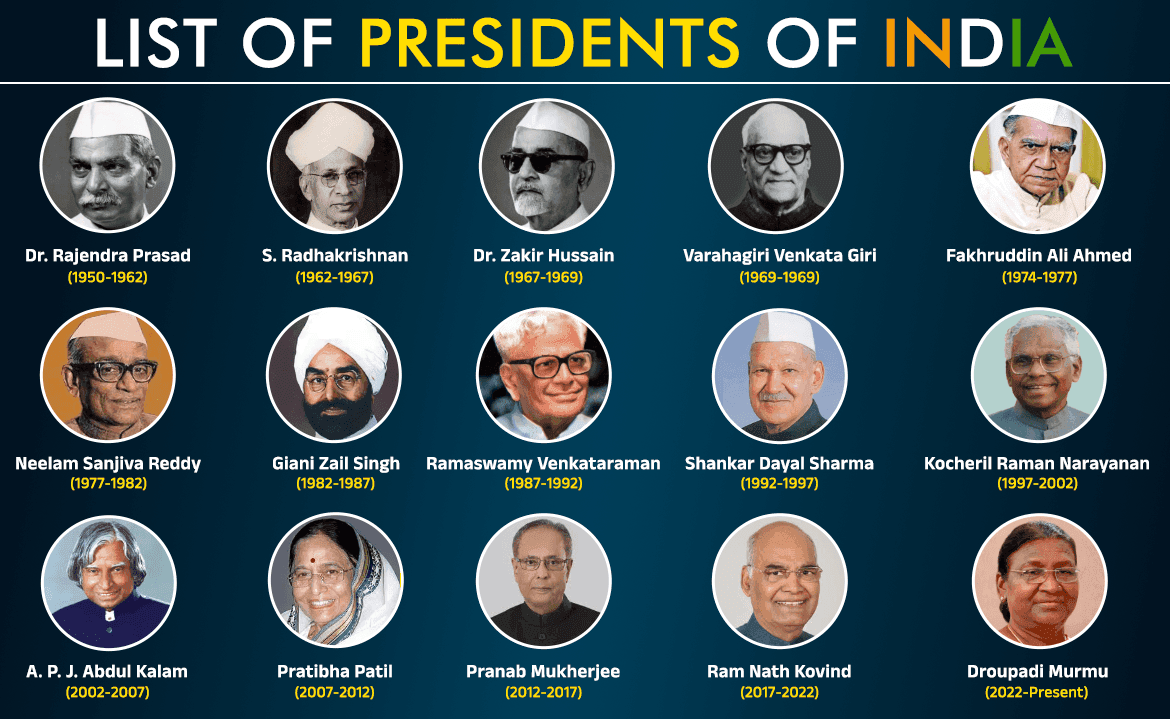 |
| List of all presidents of India with their photo |
📋 Detailed List of Presidents of India
1. Dr. Rajendra Prasad (1950–1962)
First President of India
Longest serving (12 years)
Played a key role in framing the Constitution
2. Dr. Sarvepalli Radhakrishnan (1962–1967)
Philosopher and scholar
Promoted education and intellectual growth
Teachers’ Day celebrated on his birthday
3. Dr. Zakir Husain (1967–1969)
First Muslim President
Strong supporter of education
First President to die in office
4. V. V. Giri (1969–1974)
Became President after acting role
Only independent candidate to win election
5. Fakhruddin Ali Ahmed (1974–1977)
Signed Emergency declaration (1975)
Second President to die in office
6. B. D. Jatti (Acting President, 1977)
Served temporarily
Ensured constitutional continuity
7. Neelam Sanjiva Reddy (1977–1982)
Only unopposed President
Served during post-Emergency political changes
8. Giani Zail Singh (1982–1987)
First Sikh President
Faced political tensions with Prime Minister
9. R. Venkataraman (1987–1992)
Managed coalition politics
Guided nation through instability
10. Dr. Shankar Dayal Sharma (1992–1997)
Known for discipline and constitutional integrity
11. K. R. Narayanan (1997–2002)
First Dalit President
Assertive and active in decision-making
12. Dr. A. P. J. Abdul Kalam (2002–2007)
Scientist and “People’s President”
Inspired youth and promoted education
13. Pratibha Patil (2007–2012)
First woman President
Focused on women empowerment
14. Pranab Mukherjee (2012–2017)
Highly experienced politician
Played key role in economic and political decisions
15. Ram Nath Kovind (2017–2022)
Advocate for social justice
Emphasized inclusive development
16. Droupadi Murmu (2022–Present)
First tribal woman President
Represents marginalized communities
Symbol of inclusive democracy
🌟 Important Facts & Highlights
The President is the Supreme Commander of Indian Armed Forces
Residence: Rashtrapati Bhavan (New Delhi)
Salary (revised): ₹5 lakh per month
Can veto bills:
Absolute veto
Suspensive veto
Pocket veto
First woman to contest Presidential election: Lakshmi Sahgal (2002)
Shortest tenure: Zakir Husain (due to death)
📌 Conclusion
The President of India holds a position of great dignity, responsibility, and constitutional authority. Though largely ceremonial, the role becomes extremely powerful during constitutional crises and emergencies.
From Dr. Rajendra Prasad to Droupadi Murmu, every President has contributed to shaping India’s democratic system and maintaining the spirit of the Constitution.
That's all about president in this blog .
✨ This topic is very important for exams like UPSC, SSC, and school boards, as it covers polity, governance, and constitutional framework in detail.
Nice trick
ReplyDeleteVery good trick
ReplyDeleteHi
ReplyDelete